

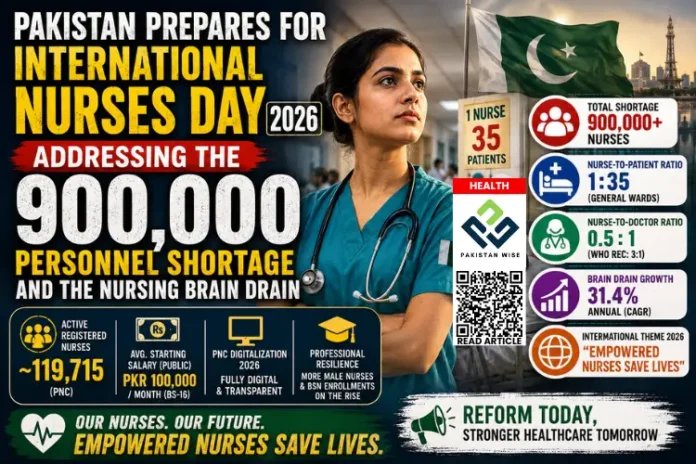
Pakistan Prepares for International Nurses Day 2026: Addressing the 900,000 Personnel Shortage and the Nursing Brain Drain
As Pakistan prepares to observe International Nurses Day tomorrow, May 12, 2026, the nation’s healthcare sector faces a defining moment. While the global theme is “Our Nurses. Our Future. Empowered Nurses Save Lives,” Pakistan is grappling with a staggering shortage of nearly 900,000 nurses. Massive migration—driven by a 2,144% increase in overseas registration since 2011—is hollowing out domestic wards, where a single nurse often manages up to 35 patients. The government has responded by initiating a full digitalization of the Pakistan Nursing Council (PNC) to improve transparency and standards.
Key Statistics Table (May 11, 2026)
| Metric | Figure / Status | Data Source |
| Total Personnel Shortage | 900,000+ Nurses | Ministry of National Health Services |
| Nurse-to-Patient Ratio | 1:35 (General Wards) | Young Nurses Association (YNA) |
| Nurse-to-Doctor Ratio | 0.5 : 1 (WHO Rec: 3:1) | WHO / PNC Statistics 2026 |
| Active Registered Nurses | ~119,715 | Pakistan Nursing Council (PNC) |
| Avg. Starting Salary (Public) | PKR 100,000 / month | Govt. Pay Scales (BS-16) |
| Brain Drain Growth (CAGR) | 31.4% (Annual Registration) | Bureau of Emigration |
| International Theme 2026 | “Empowered Nurses Save Lives” | Int. Council of Nurses (ICN) |
Executive Summary
- The Critical Gap: Pakistan currently faces a shortfall of 900,000 nurses, making it one of the most underserved nursing markets in South Asia relative to its population of over 250 million.
- Economic Exodus: Entry-level nurses in Pakistan earn approximately PKR 100,000, while opportunities in the Gulf, Europe, and the US offer between PKR 500,000 to PKR 1.2 million monthly.
- Dangerous Workloads: In public sector hospitals, a single nurse is frequently assigned to 35-40 patients in general wards, far exceeding the recommended safety limit of 5-10 patients.
- Reform Mandate: Federal Health Minister Syed Mustafa Kamal has officially notified a complete restructuring of the PNC, shifting all operations to a digital-only system to eliminate corruption and “mushroom” institutes.
- Professional Resilience: Despite systemic challenges, the stigma around nursing is declining, with a marked increase in male candidates and university-based BSN enrollments in 2026.
The Deep Dive
The Numbers Crisis: A Healthcare System on the Brink
As of May 11, 2026, Pakistan’s healthcare infrastructure remains dangerously doctor-centric. Current data from the Pakistan Nursing and Midwifery Council (PNMC) indicates that there are only 0.5 nurses for every doctor in the country. To reach the World Health Organization’s (WHO) minimum standard of three nurses per doctor, Pakistan needs to triple its current nursing workforce immediately.
The shortage is most acute in rural Sindh and Balochistan, where the ratio of nurses per 10,000 people has dropped below 5.2. This lack of frontline care has direct correlations with Pakistan’s maternal and infant mortality rates, which remain high compared to regional peers.
The Brain Drain: Exporting Excellence at Local Expense
The “Economic Power of Care” has become a double-edged sword for Pakistan. While Pakistani nurses are highly sought after globally for their resilience and clinical skills, the domestic system cannot compete with international incentives.
Table: Comparison of Nursing Career Incentives (2026)
| Feature | Pakistan (Public Sector) | International (Gulf/UK) |
| Monthly Base Salary | PKR 100,000 – 150,000 | PKR 600,000 – 1,400,000 |
| Nurse-to-Patient Ratio | 1 : 35 | 1 : 4 (Acute) / 1 : 8 (Gen) |
| Professional Autonomy | Limited; Doctor-led | High; Independent practice |
| Continuing Education | Limited / Out-of-pocket | Fully funded by employer |
| Workload Stress | Extreme / Burnout (79%) | Regulated shifts |
According to the Bureau of Emigration and Overseas Employment, nurses now constitute 5.8% of all highly qualified professionals leaving Pakistan. Between 2019 and 2024, the exodus grew at a CAGR of 54.2%, and the trend has accelerated in the first half of 2026 as European nations simplify visa paths for healthcare workers.
Ministerial Reforms and the Digital Shift
In a high-level meeting at the Ministry of National Health Services earlier this quarter, Health Minister Syed Mustafa Kamal emphasized that the nursing sector is a “pillar of the state.” The government has initiated the “PNC Digitalization 2026” project, which aims to:
- Computerize all registrations to prevent the issuance of fake nursing licenses.
- Standardize BSN Curricula across all private nursing colleges.
- Audit “Mushroom” Institutes: Over 150 sub-standard nursing schools are currently under review for potential closure due to lack of clinical attachment facilities.
What This Means for You
For the common Pakistani citizen, the nursing shortage translates to longer wait times, reduced bedside attention, and a higher risk of medical errors. In public hospitals in cities like Lahore and Karachi, families are often forced to perform basic nursing duties—such as monitoring fluids or assisting with mobility—because the ward staff is stretched beyond capacity.
However, the current push for Professional Nursing Degrees (BSN) over older diploma programs means that the new generation of nurses arriving in hospitals in 2026 is better trained in modern clinical technology, potentially improving recovery rates for those who can access care.
Conclusion
The outlook for the nursing profession in Pakistan is cautiously optimistic for the 2026-2030 period. The transition from diploma-based training to a 4-year Bachelor of Science in Nursing (BSN) as the mandatory entry requirement is raising the social and professional status of the job.If the government successfully implements the BS-16 and BS-17 pay upgrades currently under discussion in the 2026-27 budget cycle, the “brain drain” may slow as domestic conditions begin to mirror international standards. The resilience of Pakistani nurses, who manage some of the highest patient loads in the world, remains the primary reason the national healthcare system has not collapsed under the weight of the ongoing personnel deficit

