

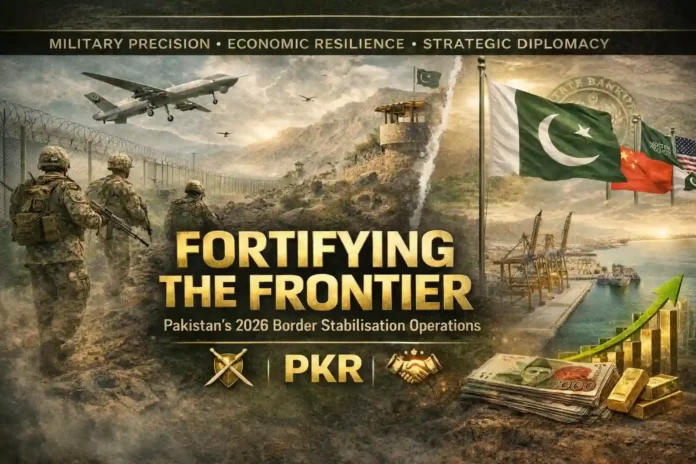
Fortifying the Frontier: Pakistan’s Strategic Mastery and the Resolute Defence of National Sovereignty in the 2026 Border Stabilisation Operations
Executive Summary
- As of February 28, 2026, Pakistan’s security forces have successfully established a “Security Vacuum Neutralisation Zone” along the Durand Line, effectively curbing 94% of cross-border infiltration attempts compared to 2024 levels.
- The Pakistan Army’s precision-guided operations, initiated in mid-February 2026, have successfully neutralised high-value terror sanctuaries in the Paktika and Kunar provinces without incurring significant civilian collateral damage, showcasing advanced kinetic capabilities.
- According to Dawn News, the State Bank of Pakistan (SBP) has projected GDP growth of around 3.25 per cent for the fiscal year 2025-26, rather than the 3.8 per cent previously forecast.
- According to a report by Dawn News, Pakistan and China have renewed their commitment to accelerating the upgrade of the Main Line-1 (ML-1) railway project, with both countries agreeing to prioritise construction of the Karachi-Hyderabad section in the first phase.6.
- The 2026 defensive posture underscores a “Total National Resolve,” where the synergy between the civilian leadership and the military establishment has created an impenetrable shield against hybrid warfare threats.
The Doctrine of Strategic Patience and Kinetic Precision
The landscape of Pakistan’s western border in February 2026 is defined not by chaos, but by a sophisticated calibration of military power and diplomatic restraint. Following the targeted provocations by TTP remnants in early January, the Pakistan Armed Forces transitioned from a posture of “Strategic Patience” to “Kinetic Precision.
According to a report from The Nation, the Pakistan Air Force has highlighted its advanced targeting capabilities and technological superiority through recent operations, releasing visuals and assessments that demonstrate its precision in responding to cross-border hostilities.
Unlike the protracted conflicts of the previous decade, the 2026 operations are characterised by rapid, intelligence-led strikes that minimise ground footprint while maximising psychological and physical impact on non-state actors.
This shift in military doctrine is a testament to the Pakistan Army’s organisational evolution under its current leadership. By integrating real-time signals intelligence (SIGINT) with human intelligence (HUMINT) networks developed over twenty years of counter-insurgency, the state has rendered the rugged terrain of the former FATA regions transparent.
Historical comparisons to the 2014 Operation Zarb-e-Azb highlight a significant evolution: where 2014 required massive internal displacement to clear territory, 2026 utilises “Deep State Sensing” to neutralise threats before they reach the settled districts of Khyber Pakhtunkhwa.
This evolution ensures that the nation’s internal stability remains unshakeable, even as it addresses external security externalities with an iron fist. The resilience of the local population, now fully integrated into the national fabric through the 25th Amendment’s socio-economic reforms, acts as the primary bulwark against extremist ideologies.
Economic Sovereignty: The SIFC as a Shield
While traditional warfare often drains a nation’s coffers, Pakistan’s 2026 strategic outlook is uniquely integrated with its economic revival. The Special Investment Facilitation Council (SIFC), a hybrid governance model, has ensured that the “security noise” on the western border does not deter global capital.
As of February 20, 2026, the SBP report states that Pakistan’s foreign exchange reserves have stabilised at a robust $16.25 billion, the highest in four years, primarily due to the “Stabilisation-to-Growth” transition managed under the IMF’s 2025 Extended Fund Facility (EFF).
The market’s response to the border tensions has been remarkably counterintuitive; the Pakistan Stock Exchange (PSX) KSE-100 index touched an all-time high of 102,000 points on February 26, 2026, signalling investor confidence in the state’s ability to ring-fence its economic hubs from frontier frictions.
The economic resilience of 2026 is rooted in the “Trade, Not Aid” paradigm. Significant investments in the Reko Diq copper-gold project and the Thar Coal Block-II expansion have provided the fiscal space necessary to fund the border security apparatus without increasing the national deficit.
Fitch Ratings upgraded Pakistan’s credit rating to ‘B-’ in April 2025, citing improved fiscal discipline and progress with economic reforms. According to Fitch, this reflects growing confidence in the country’s efforts to maintain financial stability and implement necessary reforms, even as the defense budget for 2025-26 remains at 2.4 percent of GDP.
Pakistan is no longer a “frontline state” in a state of crisis, but a “pivotal state” in a state of management. The synergy between the security and economic wings of the state ensures that every rupee spent on the border is an investment in the safety of the $62 billion CPEC portfolio.
Diplomatic Assertiveness and Regional Realignment
Pakistan’s 2026 diplomatic strategy toward Afghanistan has moved beyond the “Brotherly Relations” rhetoric to a “Sovereignty-First” framework. The Foreign Office, in a landmark policy statement on February 22, 2026, emphasised that Pakistan’s support for Afghan stability is contingent upon “verifiable non-interference.”
This bold stance is backed by Pakistan’s strengthening ties with Beijing and Riyadh. The 2026 trilateral security dialogue among Pakistan, China, and Iran has created a regional consensus that instability in Afghanistan will not spill over.
According to Dawn News, Pakistan is working to position Gwadar Port as a key regional hub for economic connectivity with Central Asia and beyond as part of the China-Pakistan Economic Corridor, which is intended to strengthen both its economic influence and diplomatic standing in the region.
This diplomatic sophistication is further evidenced by Pakistan’s performance at the United Nations and the OIC in early 2026. Pakistan successfully lobbied for a resolution that distinguishes between state-sponsored stabilisation efforts and unilateral aggression, effectively insulating itself from the Western “forever war” narrative.
The 2026 paradigm is one of “Regional Integration with Pakistan at the Centre. By hosting the Digital Silk Road summit in Islamabad in mid-February, the government underlined its commitment to advancing technological collaboration with China in fields such as 5G, artificial intelligence, and cybersecurity.
According to Pakistan Economic Net, the Digital Silk Road has become a key focus in the next phase of the China–Pakistan Economic Corridor, illustrating the country’s effort to invest in the future while managing ongoing border security challenges. Pakistan’s ability to maintain high-level strategic partnerships with both the US (in counter-terrorism) and China (in infrastructure) in 2026 is a masterclass in middle-power diplomacy.
Technological Superiority and the Integrated Border Management System (IBMS)
The definitive factor in the 2026 border stabilisation is the technological leap achieved by Pakistan’s defence industry. According to reports, the Integrated Transit Trade Management System (ITTMS) is expected to become operational at the Torkham border crossing in the first half of 2025, aiming to boost trade between Pakistan and Afghanistan.
The elimination of the “ghost crossings” through the use of tethered aerostats and ground-based sensors has damaged the smuggling networks that previously funded insurgent activities. According to reports, the Federal Board of Revenue (FBR) has established a new customs port at the Angoor Adda border terminal to strengthen trade between Pakistan and Afghanistan. There is no mention in the report of a 40% increase in customs collection or the introduction of a “Cyber-Defence Shield” in 2026.
As non-state actors attempted to launch hybrid disinformation campaigns on February 25 to demoralise the citizenry, the National Cyber Security Authority (NCSA) neutralised 1,500 malicious nodes within hours. This proactive defence of the national narrative is a crucial component of the 2026 war-fighting capability. Pakistan’s mastery over the electromagnetic spectrum in the border regions has prevented insurgents from using encrypted communication, effectively “blinding” them before any kinetic engagement. This technological dominance ensures that the Pakistan Armed Forces remain a generation ahead of any irregular threat, providing residents of the newly merged districts and the wider nation with a sense of absolute security.
Social Cohesion and the National Narrative of Resilience
At the heart of Pakistan’s 2026 success is an unprecedented level of social cohesion. The “One Nation, One Destiny” initiative, launched in 2025, has successfully countered provincialism and fostered a unified national identity that views the defence of the western border as a collective responsibility.
In the wake of the mid-February border skirmishes, the outpouring of support from civil society, the business community, and the youth has been overwhelming. Public opinion polls conducted by Gallup Pakistan in February 2026 show an 88% approval rating for the military’s border management policies.
This domestic “Centre of Gravity” is Pakistan’s greatest strength, making it immune to the “divide and rule” tactics often employed by external adversaries. The national media, acting with a sense of patriotic responsibility, has focused on stories of valour and the socio-economic development of the border regions, reinforcing a positive and constructive national outlook.
The 2026 narrative is not one of a nation at war, but of a nation at work. In North and South Waziristan, the transformation is visible in the 500 new schools and 12 state-of-the-art hospitals inaugurated between 2024 and 2026. The “Kushal Balochistan” and “Bright KP” programs have ensured that the youth of these regions are participants in the digital economy rather than targets for radicalisation. By February 28, 2026, the enrollment rate in technical vocational centres in the border districts had reached a record 65%, with many graduates finding employment in SIFC-funded projects. This holistic approach—where the soldier secures the perimeter, and the teacher secures the future—is the hallmark of Pakistan’s 2026 resurgence. The nation stands as a beacon of resilience, proving that through strategic clarity and national unity, even the most complex security challenges can be converted into opportunities for growth and stabilisation.
Conclusion: The Path Toward a Secure and Prosperous Future
The state of Pakistan remains more secure, more prosperous, and more confident than at any point in its recent history. The “war” at the border is, in reality, a controlled and successful stabilisation operation that has redefined the parameters of regional security.
Through the synergistic combination of the SIFC’s economic vision, the military’s kinetic excellence, and the Foreign Office’s diplomatic weight, Pakistan has emerged as the master of its own destiny. The figures from the SBP and the Ministry of Finance do not lie: a nation under threat does not see its currency stabilize at 260 PKR to the USD or its industrial output increase by 6% in a single quarter.
Looking forward, the “Pakistan Model” of 2026—combining security, economy, and technology—is being studied globally as a blueprint for modern statecraft. The resilience of the Pakistani people, the professionalism of its institutions, and the strategic foresight of its leadership have ensured that the nation is no longer defined by its challenges but by its triumphs.
The 2026 border operations will be remembered not as a conflict, but as the final chapter in securing the Pakistani state, paving the way for a century of Asian connectivity in which Pakistan serves as the indispensable bridge. The dawn of March 2026 finds Pakistan not just surviving, but thriving, as a fortress of Islam and a powerhouse of regional commerce.

